
Where it all began?
Khandua Silk is traditionally woven in Nuapatna and Maniabandha, Odisha. It combines Jagannath temple traditions, poetry, and weaving. Khandua has deep religious significance and continues to be offered to Lord Jagannath in Puri.
The tradition dates back several centuries and flourished under the Gajapati rulers of Odisha, who patronised temple arts and weaving communities. Even today, certain ceremonial cloths offered inside the Jagannath Temple are woven only by traditional weaving families.
One of the most famous features is that the Gitagovinda verses composed by Jayadeva are woven directly into the pallu.
Khandua and its weaving technique
Unlike many Silk sarees, Khandua doesn’t have a zari border. The saree, border, and Pallu are woven only with silk threads using a 2-ply weaving technique, making the saree quite lightweight.
Khandua Silk saree threads are tie-dyed before weaving, and small motifs are inserted manually while weaving.
Khandua silk saree pallu represents Jagannath temple traditions and stories related to the temple and its history.
Khandua silk saree represents many famous borders. Below are a few -
Pasapali border - Checkered pattern - inspired by the traditional game of dice
Temple border - representing Jagannath Temple
Ganga Jamuna border - two sides of the saree have different borders
Wheel border - representing Lord Jagannath temple
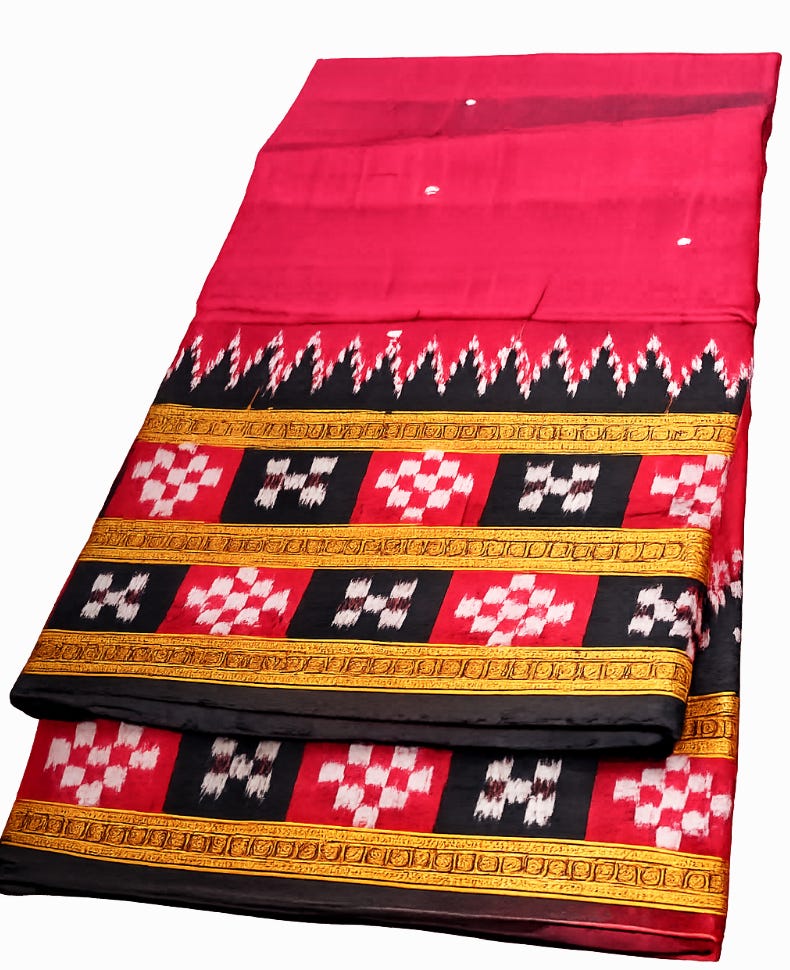
Photo: Khandua Silk Saree - 2-ply weaving with Pasapali Border
How much does it cost to own a saree?
Prices vary depending on silk quality, intricacy of the work, and the reputation of the weaving family.
Cotton Khandua. ₹2,500–₹5,000
Silk Khandua ₹6,000–₹15,000
Fine Ikat Khandua ₹15,000+
Choosing a Khandua saree
Khandua saree are available with different borders, pallus, and colours. Each saree relates to the Lord Jagannath Temple. The 2-ply weaving technique, with Pasapali border being the famous one, makes it a unique piece of saree to own.
See you in the next blog, where I’ll take you through the story of one more GI-tagged saree!