
Where it all began?
Kancheepuram, a town in Tamil Nadu, has been an important centre of silk weaving in India. The growth of Kancheepuram is closely connected with South Indian temples and rulers - the Pallavas and Cholas. The architecture and mythology eventually found their way into the sarees woven there.
Rich in colour and zari, the Kancheepuram saree has become a part of weddings, celebrations and the heritage of South India.
Making of Kancheepuram silk saree
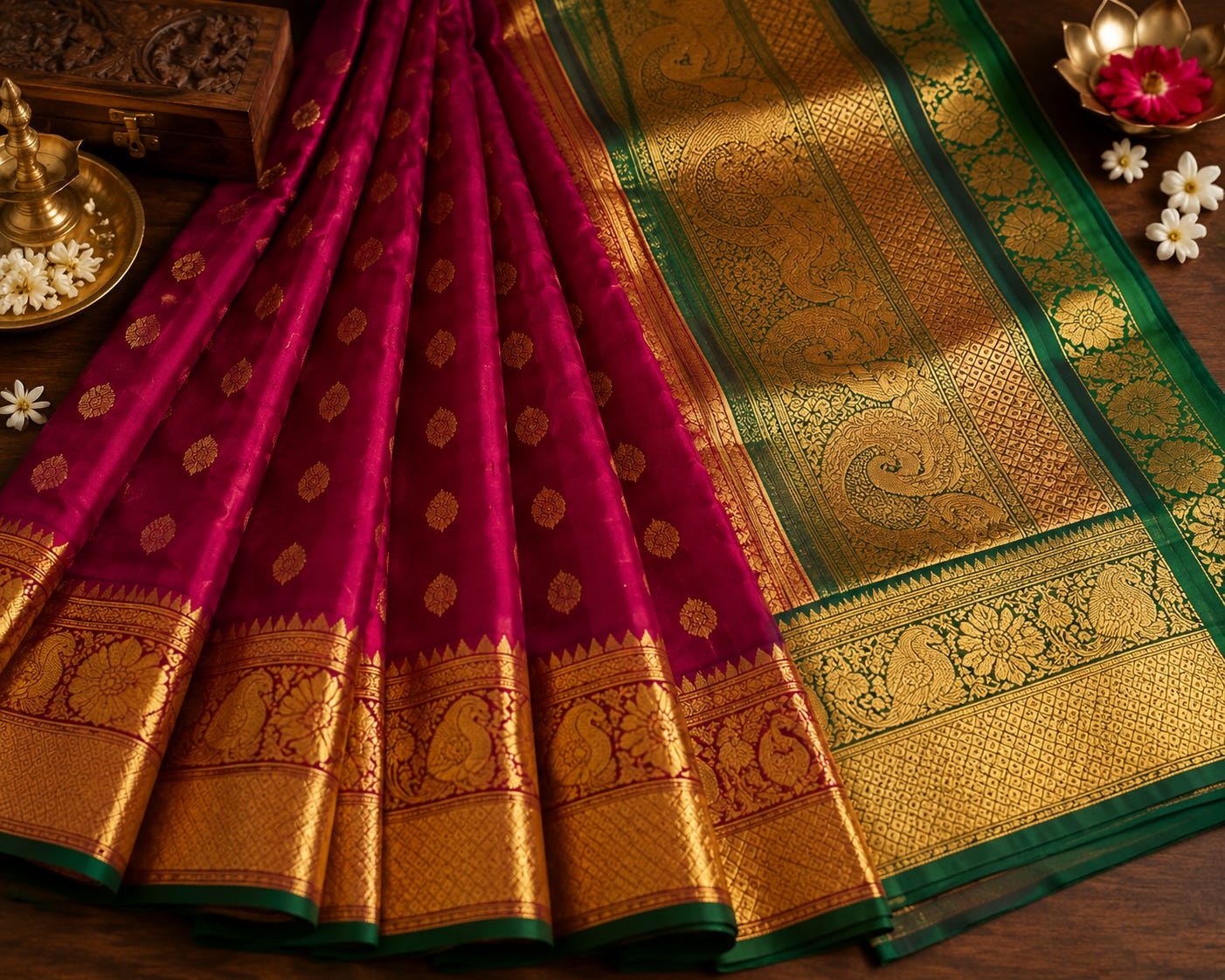
The making of a traditional saree involves silk yarn preparation, dyeing, designing, setting up the loom, weaving, and finishing. These sarees have extraordinary motifs like peacock, mango, rudrakshi, and temple.
The zari is one of the defining characteristics of Kancheepuram silk. Traditional zari is made using a silver core covered with gold. The amount and quality of zari, its purity, the complexity of the design and the quantity of silk all contribute to the final price.
Kancheepuram sarees types
There isn’t one single type of Kancheepuram saree. The variety comes from the combination of silk, zari, motifs and weaving techniques.
Classical Sarees - The classical saree has a rich silk body with a contrasting border and elaborate zari.
Korvai Sarees - These feature the interlocked joining of body and border.
Tissue Sarees - Woven with a higher proportion of zari, giving the saree a lighter, shimmering appearance.
Checks and Stripes - Geometric designs are combined with traditional borders and zari motifs.
How much does a saree cost?
Kancheepuram silk ₹8,000–₹20,000
Traditional handwoven silk ₹20,000–₹40,000
Bridal sarees ₹40,000–₹80,000
Premium weaver pieces ₹80,000+
The price depends on quality and quantity of silk, zari composition, complexity of motifs and Korvai work. Hence, price alone should never be used to determine authenticity.
How to identify an authentic saree?
Silk Mark - Authentic silk products must carry the Silk Mark certification.
GI-Tag - A GI-Tag can provide useful information about the product and its weavers.
Zari type - Check whether the zari has been certified.
More than a saree
Perhaps the most beautiful thing about a Kancheepuram saree isn’t limited to the silk or zari, but also to the motifs and weaving technique that may have travelled through generations before it becomes a Kancheepuram saree.
See you in the next blog, where I’ll take you through the story of one more GI-tagged saree!