
Origin of Ilkal Saree
Ilkal sarees take their name from the town of Ilkal in the present-day Bagalkot District of Karnataka.
The weaving tradition dates back to the 8th century, during the Chalukya dynasty. Weaving later flourished under other dynasties, including the Rashtrakutas, the Vijayanagara Empire, and other rulers.
Unlike many silk sarees woven entirely from a single continuous warp, Ilkal sarees are woven with a distinctive method of joining the body with pallu. This hallmark remains unique to this day.
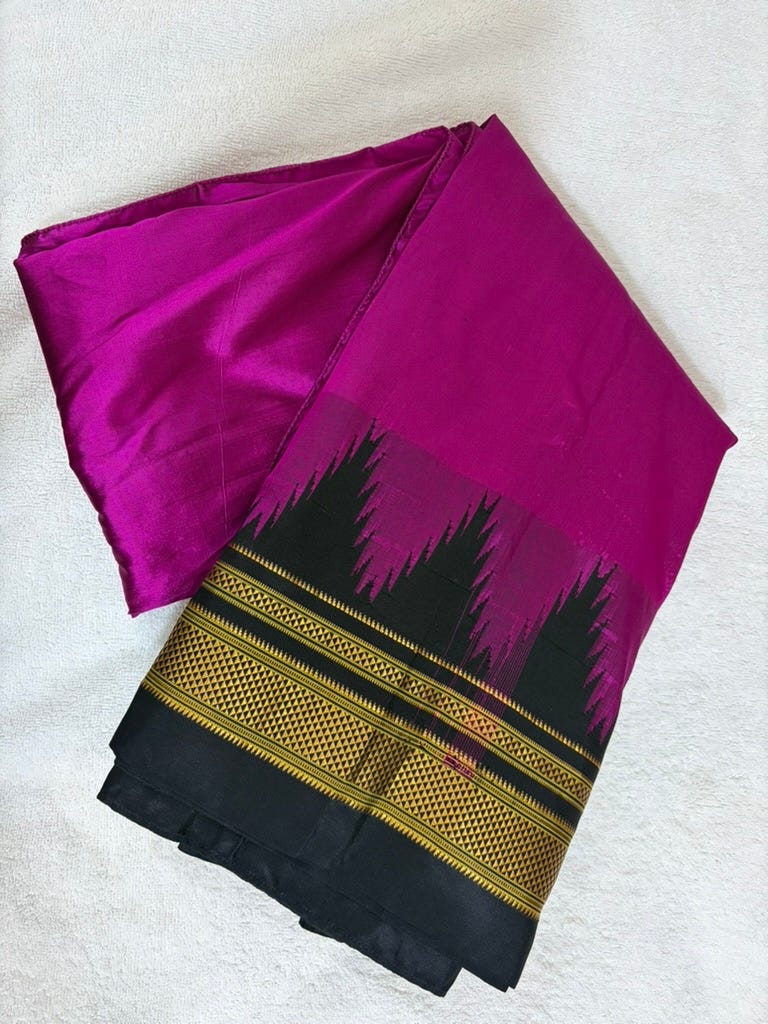
Picture: A pure-silk Ilkal Saree from my collection
Why are Ilkal Sarees so famous?
1. The Tope Teni Technique - The most distinctive feature is the Tope Teni technique. Here, the body and pallu are woven separately and then locked manually together on the loom through a meticulous loop-interlocking structure.
2. Pallu - The pallu usually features three solid stripes, alternating white bands. This bold striped pallu immediately identifies an Ilkal saree.
3. Borders - Chikki paras, Gayatri and many others
Ilkal sarees are woven in -
Cotton
Pure Silk
Silk-Cotton - The most famous combination. The saree is woven as a cotton body with silk pallu and border.
Price Range of Ilkal Saree
Cotton - ₹1,500–₹4,000
Silk-Cotton - ₹3,000–₹8,000
Silk - ₹6,000–₹15,000
Premium Silk - ₹15,000+
Styling an Ilkal Saree
Ilkal sarees were typically worn with Khun blouses, which is also a GI-Tag textile.
Kasuti embroidery (which also has a GI-Tag) is also done on Ilkal sarees, which gives all of us a reason to own not one saree but many more.
I shall write more about them in my future blogs!
See you in the next blog, where I’ll take you through the story of one more GI-tagged saree!