
Where It All Began
The story of the Banarasi saree stretches back further than most people expect — some historians trace silk weaving on the banks of the Ganga at Kashi itself, while others point to weavers from further south, even Kanchipuram, who settled in Varanasi during Emperor Akbar’s reign and brought their own silk expertise along with them.
Whatever the exact route, the outcome was the same: Varanasi became a city where gold and silver zari threads were worked into silk with a precision that, at first, made these sarees fit only for royalty.
For me, though, the story began somewhere much smaller. I was in grade 1, playing Lata Mangeshkar in a school performance, singing “Mile Sur Mera Tumhara,” and draped in my grandmother’s Banarasi saree for the occasion. I don’t remember much about the performance itself, but I remember exactly how that saree felt — and looking back, I think that’s the moment the obsession quietly started, years before I understood a word of what made a Banarasi a Banarasi.
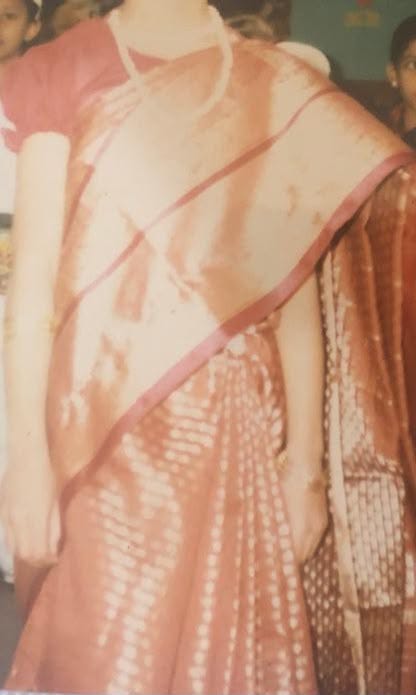
Photo: My Grandmother’s 4-decade-old Banarasi saree
What Makes It Special
What sets a Banarasi apart isn’t just the silk — it’s the craftsmanship packed into it. These sarees are woven using a weft technique, which means the motifs are built into the fabric as it’s woven, thread by thread. Depending on how intricate the design is, a single saree can take anywhere from 15 days to several months to come off the handloom.
The Types of Banarasi Silk and Sarees
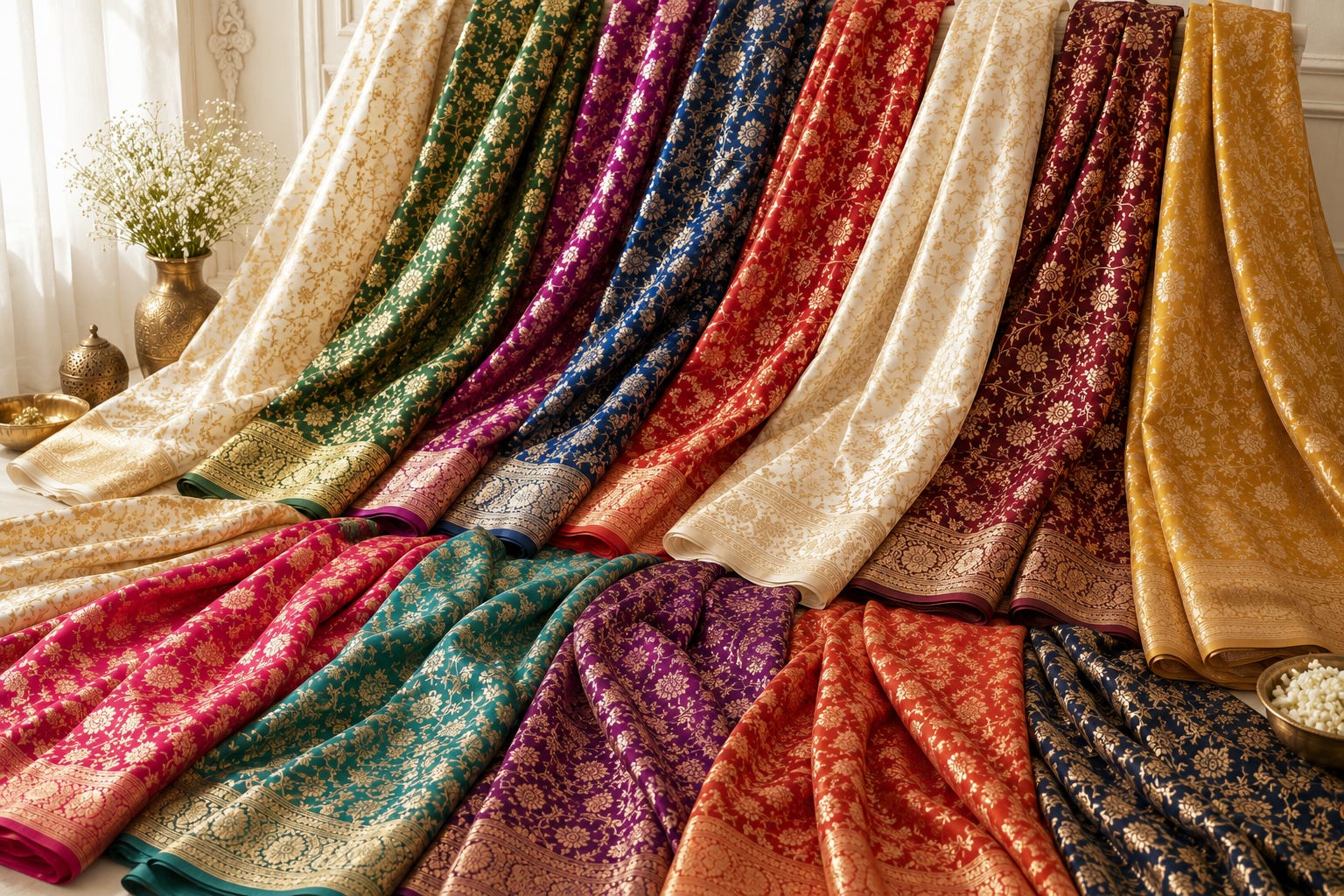
Not all Banarasi sarees are cut from the same fabric. The fabric base alone varies quite a bit: Katan Silk, Organza/Kora, Georgette, Tissue, Shattir, to name a few.
Beyond the base fabric, it’s the weaving technique where a Banarasi earns its personality — Katan Banarasi, Organza Banarasi, Shattir Banarasi, Georgette Banarasi, Kadhwa, Cutwork, Kadhiyal, Tanchoi, Meenakari, among others.
The Patterns: Jaal and Others
If there’s one design word every Banarasi lover should know, it’s Jaal — literally “net” — a design where a small motif called a booti is enclosed within a network of geometric or curvilinear lines that spread across the entire body of the saree. Beyond the Jaal, keep an eye out for Shikargah, Kalga and Bel, Jhallar, and the recurring cast of paisleys, peacocks, and elephants.
When Did It Get Its GI Tag?
The Banarasi saree — officially registered as “Banaras Brocades and Sarees” — received its GI tag on September 4, 2009, following an application filed in 2007 by nine organisations, led by the Banaras Bunkar Samiti and the Human Welfare Association. The tag protects weavers in Uttar Pradesh from having sarees produced elsewhere - sold under the “Banarasi” name- and it directly benefits the roughly 12 lakh people connected to the region’s handloom silk industry. A logo version of the same GI registration followed in 2012–13, adding a visual mark of authenticity that’s even harder to fake.
Price Range
Prices swing enormously depending on the silk base, the weaving technique, and how much handwork went into the motifs:
Entry-level authentic Banarasi: roughly ₹4,000–₹8,000
Mid-range Katan or Organza with moderate zari work: ₹8,000–₹25,000
Heavily worked Kadhwa, Tanchoi, or bridal-grade pieces: ₹25,000–₹80,000, and upward for true heirloom-quality weaves
As a rule of thumb: if a “pure Banarasi silk saree” is being offered for a couple of thousands, it’s very likely a power-loom imitation rather than the real, handwoven thing.
When in doubt, ask for the Silk Mark tag or GI authentication — a shop confident in what it’s selling won’t hesitate to show you.
See you in the next blog, where I’ll take you through the story of one more GI-tagged saree!